Lobotomy Corporation Stats and XP script
Lobotomy Corporation's weirdly complex Stats and XP Mechanics (No Spoilers*)
| Script | Notable On-screen blurbs | Additional notes and credits |
|---|---|---|
| In a previous video, I showed this formula on screen...
...then went on to say that you shouldn't pay too much attention to it and instead just work on the riskiest Abnormalities that you can handle. Turns out I was right, had I explained all of this properly, I would've derailed that video and easily doubled it in length. But at the same time, turns out I was also wrong: after spending some time going through the rabbit hole of Lobotomy Corporation's code, I learned about a mistake that almost every player makes when grinding for XP, and it goes against the advice I gave. So if you've already finished the game and you're just here for the clickbait, skip to the timestamp on screen. For the rest, I'll be giving you a tour of the game's weirdly complicated Stats and Leveling mechanics. |
(for the timestamp, scroll down and look for the CLICKBAIT row) | Lobotomy Corporation - Essential Beginner Tips |
| First, I'll run through some basics about Agent Stats, including the game's Color system.
Next we'll go over the main topic, the Leveling process. Then we'll expand upon what we just covered and see how deep the Stats rabbit hole goes. Like with most of my guide videos, I will be avoiding spoilers. However, I have to spoil some early game Abnormalites to show some concrete examples on how the mechanics work. If this is still too much of a spoiler for you, come back later once you've fully researched most of them. Another problem with avoiding spoilers is I also have to avoid talking about some gameplay mechanics that change in the late game. Rather than wait for another video, I'll just shove them to a short Appendix at the end of this one. I strongly suggest skipping this part until you've reached the final stretch of the game. |
What We'll Cover
(Spoiler-free)
+APPENDIX (full spoilers) |
|
| A bit of a disclaimer before we continue…
Most of the info I'll be discussing comes from decompiling the latest version. While I've verified them through testing, and I will show examples throughout this video, there's a possibility that the decompiled code is inaccurate or more likely, I read the code wrong and the examples may just be a coincidence. Long story short, don't treat this video as 100% correct and check the comments for any major corrections. |
Decompiled version: Steam v1.0213f1 | |
| Agent Stats Mechanics | ||
| Alright, let's start with the basics.
Your agents have 4 Primary Stats, or Virtues in game terms: Fortitude, Prudence, Temperance, and Justice. Each corresponds to 1 or more Secondary Stats: Fortitude determines the Agent's base max HP in game, with each point equal to 1 HP. Prudence does the same for SP. The next two aren't as simple. |
||
| Temperance affects the Work Success Rate and Work Speed.
This is what you see when you order your Agents to work on Abnormalities. ...after you unlock all the Work Preferences. This info window doesn't tell you the actual Success Rate; instead, the text gives you the ranges where your Agent's Success Rate falls into, with “Very Low” meaning there's less than 20% chance of success per attempt at extracting a Positive Enkephalin box, “Low” less than 40%, “Common” at the middle at less than 60%, then “High”, and finally “Very High” at greater than or equal to 80%. Success Rate is capped at 95%, and some penalties are applied after that ceiling. Now that we've explained the mechanics, let's go back to Temperance and the Success Rate stat. |
||
| Each point of the Virtue leads to 0.2% better chance of work success.
That may not seem much, and in many cases it really isn't, but since the game adds it to the base Success Rate rather than multiplying it, the effects of a high Success Rate stat can be huge. |
125 extra Temperance = +25%
Added to base 50%, the bonus is effectively +50% (50% vs 75%) On a 25%, it's +100% (25% vs 50%) |
|
| Each Temperance point also contributes to 1% faster work speed.
I won't go into detail with the numbers because it's a bit more complicated than Success Rate, but basically a 130 Work Speed Agent will work twice as fast as one as a 15 Work Speed Agent. |
Work Time is rounded up, the real values are 28.99s and 14.49s | |
| And finally Justice, contributing to Attack and Movement Speed.
These are even more complicated than the Temperance stats, being tied to Unity's physics engine. But to keep things simple, you can also treat them as “1 point equals to 1%”, with the same 15 vs 130 comparison. The numbers don't quite match if you look real closely, but it's close enough for practical purposes. |
||
| A stat's value also determines its Level, as shown by the following table:
Starting with Level 1 for stats less than 30, up to 5 for stats 85 and up. The game uses these levels to look up success rates for working with Abnormalities, and also uses it in other places, like requirements for equipping E.G.O. |
I stat < 30 II 30 <= stat < 45 |
|
| Adding up stat levels gives you the Agent Level.
Similar to the stats, this goes from Level 1 for Agents with total stats less than 6 to Level 5 for those with a total of 16 or higher. |
I total < 6 II 6<= total < 9 |
|
| Like Primary Stat levels, Agent levels are used all over the game, like how more senior Agents take less SP damage when working on or suppressing Abnormalities. | Higher leveled Agents take less Fear damage on Work or Suppression
|
|
| Work and Damage Types (Color System) | ||
| Before we talk about Work, we might as well talk about the 4 colors and the damage types.
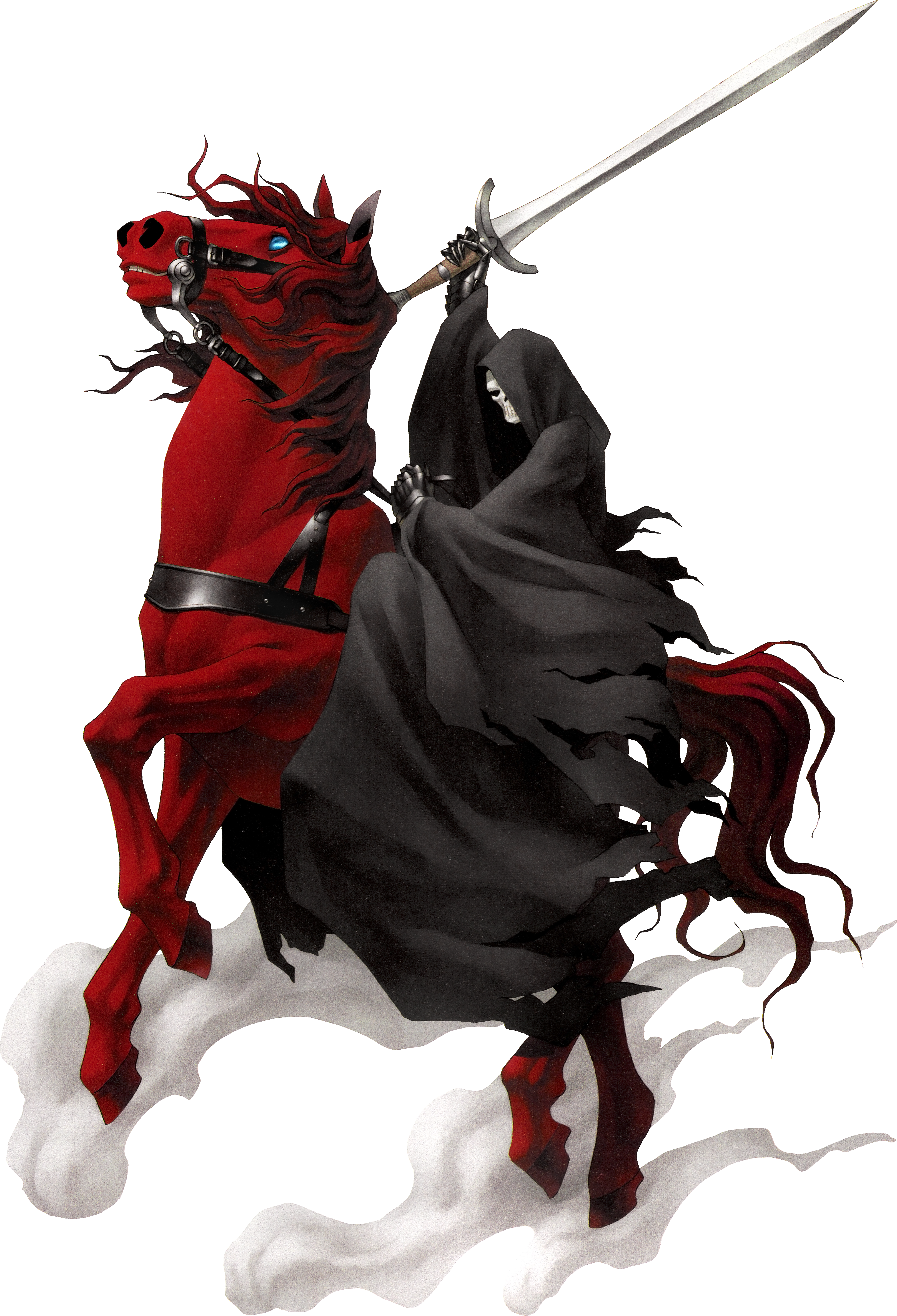
As you may have noticed, Lobotomy Corporation doesn't use the usual classical elements for its types, but instead goes for the biblical Four Horsemen of the Apocalypse. Fortitude is Red. And to no one's surprise, Red damage affects HP. Prudence is White, and White affects SP, both damaging it or healing it. Temperance is Black, but since Black can be a challenge to show in games, it's represented by dark purple. Black damage is a combination of the previous two, damaging both. Or healing SP in the case of panicking agents. And finally, Justice is Pale. The in-game color might not match some translations of arguably the most popular horse, but light cyan has its own ties to Death. Anyway, Pale deals percent damage of the target's max health. So if after all the attack and defense calculations we end up with 1 Pale damage, it will deal 1% of the target's max HP. |
Revelations 6:1-8 | Classical Elements:
Four Horsemen Shin Megami Tensei III: Nocturne Maniax sprites from https://megatenwiki.com/ |
| Leveling Mechanics | ||
| Ok, let's discuss what most of you are here for, the leveling and experience mechanics.
Whenever an Agent works on an Abnormality, they earn experience for the Primary Stat they used. So if they did Instinct work which corresponds to Fortitude or Red, they'll improve that Primary Stat. Same thing for Insight with Prudence/White, Attachment with Temperance/Black, and Repression with Justice/Pale. This experience is added to the stat at the end of the day. |
||
| Unfortunately, this value is hidden.
You can see it with a mod - and for this video I'll be using the More Detailed Info Mod by Yentis from Nexus Mods. |
The UI doesn't show Experience values until the end of the day | More Detailed Info Mod by Yentis (Nexus Mods) |
| And by the way, there's a maximum value for the stats.
If a Virtue goes over 100 at the end of the day, the base stat will stay at the 100 ceiling. Simple enough so far? Let's go a bit deeper... |
||
| The game stores Primary Stats as integers, or whole numbers for normal people.
The experience, on the other hand, is stored as floating point numbers AKA not whole numbers. To see this, let's quickly modify the mod to show the raw value up to 3 decimal places. And there it is. |
Temperance XP is NOT +2, it's actually +2.14
not gonna detail what I modified, just watch the video |
Source: https://github.com/Yentis/LobotomyCorporation-MoreDetailedInfo |
| "What about rounding?" you might ask.
Well, it just uses the default rounding operation in Unity, round half to even. Not what some are used to, but that's just how it is. |
aka Banker's Rounding | Rounding references: |
| Experience Calculation Formula | ||
| With that matter out of the way, let's finally talk about the experience calculation.
Experience is based on a number of values multiplied with each other, starting with the number of Positive Enkephalin or PE boxes that the Agent successfully extracted. Then that's multiplied by a value based on the level of the Virtue used. Then multiplied to another value based on the difference between the Virtue level and the Abnormality's risk level. Then multiplied again on a factor based on the remaining HP or SP of the Agent after the work. And multiplied one last time to bonuses received from the Training Team. Let's go through them one by one. |
||
| The PE box part is self explanatory:
given two identical Agents working on the same Abnormality, receiving similar damage, but with different number of PE boxes extracted, the experience will be different but proportional. This factor also begins the trend of higher risk situations giving more experience, as higher risk Abnormalities have a higher maximum box count. |
||
| The next one's also easy, it just means that the higher the Primary Stat corresponding to the work, the less experience it will get per PE box. | XP is multiplied to a value based on the Level of Virtue used:
I 0.60 |
|
| Again, all things equal, the Agent with a higher level in the stat will get less experience. | Even with a higher PE Box count, the other factors greatly reduced the final XP value, with the Risk-Level factor giving the biggest penalty.
(basically, Agents working on abnormalities that are easy for them gives little XP) |
|
| Next is based on the risk level: a lesser skilled Agent working on Risky Abnormalities will get more experience compared to a higher skilled one.
This is calculated by first giving values to the risk levels, with Zayin being 1 and Aleph being 5, and subtracting it to the stat's level. Then this table tells you the bonus or penalty that the Agent will get to experience. |
Zayin = 1... Aleph = 5
Subtract the Risk value to the virtue (Level - Risk) to get the factor: -3 : 1.4 |
|
| Some of you might notice something missing from this table -
Where's the “-4”? Or what will happen if someone with a Level 1 stat works on an Aleph? It's the default “1”. Possibly a bug, though it's more likely that the devs weren't expecting Level 1 Agents to survive the encounter. |
||
| Let's skip the hard part and go straight to the Training team bonuses.
This value starts at 1 and increases the more bonuses you have. If you've researched Supply Education Manuals, you add 0.5 for an overall 50% bonus. Then you get a bonus based on how many Clerks are still alive, from 0 at no Clerks, to 0.05 at full capacity. Then members of the Training Team get their continuous service bonuses: a newly transferred Agent gets 0.05, one with 3-6 days in the team gets 0.1, and 7 or more days gets 0.15. The Captain, who already has +4 to all stats, will get less at 0.04. Add that all up, and you get a value from 1 to 1.7. |
||
| Damage Factor | ||
| Now comes the hard part, the damage factor.
The more an Agent is damaged during work, the more experience they'll get. For Red Work, the game checks the remaining HP of the Agent. If it's higher than 70%, they get a penalty; if lower than 20%, they get a bonus. |
XP Multiplier (remaining HP)
|
|
| Something similar happens with White Work, with the SP checked this time around. | Similar to HP | |
| Black damage affects both HP and SP, so for Black work, the average of both values are checked.
So percent of HP plus percent of SP divided by 2, not sum of HP and SP divided by sum of max HP and SP. |
Similar to HP and SP
Average = ((HP / max HP) + (SP / max SP)) / 2 NOT (HP + SP)/(max HP + max SP) |
|
| This factor works differently for Repression, namely, Pale work doesn't care about damage and instead gets a flat 0.5 regardless of the remaining health
Technically, it's a flat 1.5 bonus, but Repression also gets a "divide by 3" penalty to the Risk factor so to keep things simple we'll just combine them. Note, however, that we're talking about Pale Work here and not Pale Damage. |
||
| Pale Damage deals percent of HP so it just should be treated as a more dangerous form of Red Damage. | Pale Damage affects HP and thus treated like Red Damage when doing Instinct or Attachment work | |
| Anyway, apart from the thing with Repression, this factor is another take on the XP being tied to the risk involved.
An Agent with really high stats and equipped with late game armor won't take enough damage from low-risk Abnormalities, greatly reducing the XP they'll get. On the other hand, sending weaker Agents to tackle high risk Abnormalities and pushing them close to the boundary of death can give them huge amounts of XP if they actually survive. All of what we've talked about so far is in line with what I said in the other video, so what's the big deal with this damage factor? |
||
| Hidden Damage Factor leads to bigger problems | ||
| Simply put, it breaks a fundamental concept you learn at the start of the game.
Namely, you're taught to always perform work with the highest success rate. |
||
| Starting with One Sin, the game nudges you towards doing Attachment work as it would give you the most PE boxes every time you work on it.
Then you get your next Abnormality, say Fairy Festival. Instinct's got the highest success rate this time around, and so you send your Agents to do that work. At the end of the day, your Agent gets a huge stat gain, enforcing your belief that success rate is all that matters. The game doesn't hint that damage had anything to do with XP. |
||
| But then you get a certain type of Abnormality - one like Scorched Girl.
You find out that Insight works best, and following what you learned so far, you send your Agents to do that type of Work. At the end of the day, your Agent doesn't get quite as much XP but you just dismiss this a as a fluke; what matters is that your Agent still gained some points, and more importantly, they survived. The same couldn't be said to the Agent you sent to try out Red work and died in the process. |
||
| And so from here on out, you stick to what you know - always go for high success, and make sure your Agents take the least amount of damage as possible. | THIS IS WHERE THE TIMESTAMP FOR CLICKBAIT LEADS TO | |
| While there are flaws with this seemingly sound strategy, and we'll talk about them in a moment, it's main problem is it totally breaks down when dealing with Abnormalities where the easiest work type doesn't match the damage it deals.
If you run the numbers, matching the work with the damage type typically produces much more XP than simply going for the highest success rate. Sure, that's countered by the fact that the survival rate is much lower, but you can address that by equipping better armor or farming HP a bit beforehand. I could wrap this all up at this point by just telling you to match work with damage as much as possible, but I still think we need to look at the bigger problem with the onboarding process… |
(not copying the graphs here, just go watch the video) | |
| The Bigger Problem with Hidden Mechanics | ||
| The early game seems to imply that you should always go for high success rate work.
But prioritizing success rate means you avoid working on riskier Abnormalities, which leads to more work needed to reach the daily quota. And this in turn leads to more chances to encounter Ordeals that you may not be ready to deal with. |
1. You learn to always go for high-success, low risk work.
but Avoiding high-risk leads to longer days and more Ordeals |
|
| Eventually you learn to face the fear and start working on riskier Abnormalities more.
But to do that, you have to start intentionally grinding for specific Stats and this can be tricky when you can only find out if you've grinded enough by waiting for the end of the day. |
2. You start to work on high-risk Abnormalities, and learn to grind stats to prepare for them.
but Farming efficiently can be tricky when XP gain is hidden |
|
| That can be addressed by not treating LobCorp as a fast paced pick-up-and-play game and actually take some notes
to try to figure out what Abnormalities give decent XP for different types of Agents. Or you can cheat a little and install an XP display mod to remove all the guesswork. However, unless you learn about the damage factor, neither approach will warn you about Abnormalities with damage types that don't match their ideal work type. You will see that your Agents get lower XP, but like we said earlier, most likely you'll just think this is just a fluke, perhaps a hidden multiplier specific to each Abnormality.
|
3. You take some notes (and maybe install a couple of mods) to learn to farm better.
but it's still unlikely that you'll figure out that damage type is related to XP, leading you to farm inefficiently on some Abnormalities. |
|
| And now we can sum up the problem with the leveling system:
Lobotomy Corporation's decision to hide XP and the leveling mechanics in general makes the game seem even more tedious and repetitive than it actually is. |
||
| Not saying it isn't tedious and repetitive, it is after all a rogue-lite.
What I mean is that the game already gives you the tools to cut down on the grind, but most players will only learn at most a fraction of those tips and tricks. If this sounds familiar, yes, this is in line with the problems I outlined in the last video. But I'm not going to repeat them here and derail this video even further; just go check out that video if you want to know more. |
||
| Anyway, one way to fix this problem is to update the manual and add the details about leveling, rewarding the players who take time to read.
Or include in-game upgrades to show the intraday XP values, or better yet, show a breakdown of how the XP was calculated after a work was done. Given Project Moon's workload nowadays, I don't expect any official updates to come soon. |
||
| Unless of course you're from far in the future and watching this as you play your remaster of Lobotomy Corporation wondering why I'm talking about fixes already in the game.
For the near-future viewers, the only thing you can do is be aware of the mechanics. I wouldn't suggest manually calculating the XP, though, as it would only add unnecessary effort, something we're avoiding in the first place. And I also don't recommend installing mods that can break the experience. So instead, let's just do what I said at the start of this video and update the rule of thumb for working with Abnormalities to take into account what we just discussed... |
||
| Updated Guidelines for Abnormality Farming | ||
| If you're trying to reach the daily quota as soon as possible, working on the riskiest Abnormalities your Agents can handle remains a good strategy.
Like we said earlier, higher risk produces more PE Boxes. |
||
| However, risk goes out of the window when grinding for E.G.O.
Success rate is all that matters; you can send Agents that have stats so high that their risk of dying or going insane is practically zero. |
||
| Now for farming XP, we still go with what was said in the previous video:
it's up to you to figure out the sweet spot for each Agent and Abnormality. Too risky and you don't extract enough PE boxes and your Agents will die. Too safe and even getting all PE boxes will give low XP because your Agent's level is just too high. |
||
| We then have to take into account the damage factor -
this sweet spot approach works best with Instinct work on Abnormalities that deal Red or Pale damage, Insight on those that deal White, and Black damage and Repression as a whole, though note the lowered XP for the latter. |
||
| With Attachment work paired with non-Black damage you might want to consider taking more risk to make up for the increased damage needed to reach the thresholds.
And finally, avoid work that deals the opposite damage type as it's a guaranteed 0.4 penalty to XP. Doesn't mean you absolutely shouldn't do them, for example if there's a Meltdown and you can work on them for free. |
||
| To wrap things up, I have to remind you that Management Tips can override these guidelines.
It doesn't matter if you get a ton of XP or PE Boxes if your Agent dies or the Abnormality breaches, or worse. And that's our updated tips for farming. |
||
| Pre-damaging before Work | ||
| After seeing how we went from a simple rule of thumb to a bunch of guidelines, some of you might be thinking of a possible shortcut to all of this:
How about we let our Agents take damage beforehand, would that let us ignore the problems with the damage factor and cut down on all this effort? Short answer: it depends. Unlike what I said previously, the game doesn't simply use the Agent's max HP and SP, but instead stores their HP and SP as they enter the unit then treats those values as the maximums. So in this example of a heavily damaged Agent, they didn't take any damage, which means they still get the worst case multiplier despite the low health. |
One Sin healed 4 SP so the actual "remaining" SP is 500% (!) and the final remaining average is 300% (!) | |
| Another example, doing Insight work on Scorched Girl.
It doesn't matter if this Agent starts out almost insane; at the end of the work, it still counts as 100% SP. |
counts as 100% despite just 1 SP of 19. | |
| But if you try to do it with a matching work type, say, Instinct instead of Insight, pre-damaging will lower the damage your Agent needs to take to reach the thresholds.
Take a 95 max HP Agent, they'll need about 10 damage to get to the 0.6 threshold like they did here. Compare that to an already damaged Agent, like this one. They'll need far less damage to hit the thresholds, and here they easily got to the 1.0 range. |
||
| So yes, pre-damaging can work.
You can even do this automatically if you grind XP by stationing your Agents in front of containment units. However, it doesn't work with the main problem we higlighted: Abnormalities giving a lot less XP because they don't deal the right damage type. And that's all I have to say about how XP works. |
||
| Other Topics (Titles) | ||
| Moving on to other stuff…
Some of you might've noticed something odd about certain numbers displayed in the mod: there are two different base stats. And here's where we talk about Titles. Every Agent has two Titles, a Prefix and a Suffix, and each of them adds modifiers to the stats. Updating the mod again, we can show these Title modifiers right next to the base stat. 15 + 2 is 17, 15 + 5 is 20, and so on. Now we also see that the value on the left in the stat window is just the sum. So how does this work? When you hire an Agent, they start at Level 1 with 15 on all stats. Then the game gives the Agent their first Titles. The suffix is fixed at “Newbie” which gives +2 to all stats. On the other hand, the prefix is taken at random from a list. Most of them will give +3 to one stat and -2 to another. The lucky ones will get a Title that doesn't have that -2. Titles change once an Agent levels up through promotion or strengthening. At level 2, they get a new fixed suffix, “Employee”, but the +2 bonus stays the same. At level 4, they get a new random prefix with different bonuses. Level 3 and 5 works a bit differently. Like panicking, the game checks the highest Primary Stat then chooses randomly from a corresponding list of suffixes. For example, this Agent got promoted from Level 2 straight to Level 4 so they'll get both a new prefix and suffix. The new prefix, “Dastardly”, was chosen randomly from the Level 4 list. On the other hand, for the suffix, their highest stat is Temperance, so a random title was chosen from this list, and so they got "Assistant". In case there's a tie between two or more Stats, the “Senior” and “Grand Senior” suffixes are given at Levels 3 and 5, respectively. These titles have higher total values than the normal suffixes, but can be hard to get intentionally without an XP display mod. The “Grand Senior” is much easier, if you know what you're doing, like maxing out 2 stats at the same time just before Level V promotion. |
||
| Stats and Level Shenanigans | ||
| Now that we've talked about titles, we can finally discuss how complicated Stats actually are.
How complicated? Try quantum mechanics level of multiple states happening at the same time. |
https://commons.wikimedia.org/wiki/File:Fullrevival.gif | |
| Ok, that's an exaggeration, but the fact is every Stat can have a different value depending on the use case.
This Agent's Temperance can be treated as 15, 17 or 27 in different situations. In a normal video game, you'd mostly care about 20, which is the base stat with all the bonuses and debuffs added. And for the most part, the game follows this convention. Say if you want to get the Work Success stat of this Agent, you'd start with 20, then add on other bonuses, ending up with 25. Then when we work on an Abnormality, we start with the base success rate we looked up on the Preferences table, then add the bonus based on the Work Success stat to get the actual success rate. |
||
| Now on to the unexpected...
Let's take a look at a different Agent. Base stat is 20, Title bonus is 5, and a +7 Department bonus. That should be 32… but wait, why is the Temperance level only 1? We can confirm that this isn't a display bug by checking the success rate on Scorched Girl. Before you assume Virtue Level is based only on the Base Stat and Title, I've ordered this (Agent) to use a Tool that raises Temperance by 20… and this time it's Level 3. Again confirming with the success rate, yup, it's Level 3 now. So here's our second possible value: Base stat plus Title bonus plus EGO Bonus and plus other effects except for Department bonuses determines the Virtue level displayed as well as the one used for looking up success rates. |
||
| For the next weird case, let's take a look at another Agent.
To shake things up a bit, we'll be checking Fortitude instead of Temperance. The Agent's Fortitude is 31, the sum of 29 and 2. And as expected, the Virtue Level is 2. Doing Instinct work, the success rate numbers match up. But then after the work, the XP is 2.232, which doesn't match up - it should've been 1.637. The reason? Experience calculation only uses the Base Stat and ignores the Title effects. So when calculating XP, this Agent's Fortitude is 29, making the Level 1. Using the right numbers, we get the right result. |
||
| But we're not done.
Let's send the Agent to work again. We got 6 PE boxes again so we should get double, that is, 4.464. Huh, that's weird, we got a lower value. Ok, I lied earlier, the Base Sstat isn't the only value used when calculating for these 2 experience factors, the XP is also taken into account. For the second attempt, we finally use Fortitude Level II in the calculation, giving us 1.637 again. Add that to 2.232 and we get the number we want. Long story short, an Agent gets less XP the more they work. |
||
| But before you overthink things even more, note that this only happens once or twice a day unless you're grinding a bit too much.
And also the XP reduction isn't as big as the other factors: you're better off making sure your Agents take damage or extract enough PE Boxes than think about this problem. |
||
| So far we've got 3 different values for Virtues.
But we're not done, we still have one more to discuss before we move on to the next lesson. Remember Owen, the Agent that got their Temperance buffed to Level 3? Note how their Agent Level didn't change even though the sum of the levels are now 6. So as weird as it sounds, most effects that buff or debuff your Agents won't change their overall level. I can pump this Agent up with so many effects but they're still level 1. |
||
| And here's a summary of all of this shenanigans.
Thankfully we're done with that… at least until we get to the spoilers. |
||
| Strengthening Agents | ||
| For our last non-spoiler topic, let's talk about Strengthening your Agents through Lob Points.
Like I said earlier, Agents start out with 15 on all stats. Yes, this is true even with the Training Team upgrade that should give +5 to all starting stats. This is bugged, and that bonus can only be received through a certain way… which I'll talk about in the spoiler appendix. Anyway, when you boost a stat, the original value will not matter and a new value will be rolled based on the new level. At Level 2, this is 30 to 37, Level 3 45 to 55, and so on. Also remember that whenever an Agent gains a level, they can get new Titles. |
Random base stats when strengthening to higher level:
I n/a |
|
| And that's it for the non-spoiler-y section of this video.
As I said before, we will be dealing with very late game spoilers in the next part, so if you're just starting the game or if you're only around the midpoint, I suggest you leave. |
(Also a very minor, very early game "spoiler" for Limbus Company) | |
| Full Spoiler Appendix (Late Game Sephira/Departments) | ||
| We've mostly talked about the Training Team in this video, so it's apt that our spoilers start with Hod.
So I mentioned that the Agent levels are based on adding the primary stat's Base value and the Title bonuses only. But there's one instance where the buffs and debuffs can change the Agent's levels. Hod's Suppression. No surprise here. In fact, you may have even done a double take when I talked about buffs and levels because you were sure your Agent's levels dropped in this boss battle. And sure enough, it's only here where that happens, the game also taking into account E.G.O and other effects to get the overall Level. The Department bonuses are still ignored though, and as you may recall, this is how the game calculates the displayed Virtue level. So basically, Hod Suppression is the only time the displayed Virtue levels completely correspond to the Agent level. Everywhere else, you can't guarantee that the displayed numbers add up. |
||
| While we're still at Hod, remember what I said about the bugged research that doesn't add 5 to a new hire's stats, except in a certain situation?
If you've finished Hod's suppression, you can lower a new hire's stat level down to level 1. They will finally end up with 20 instead of 15 for that stat. Oh and yeah, lowering a stat on hire will not change the title. Combine this with the fact that they start at level 4 with a stat tie, all of your new hires will be “Senior”, regardless if you nerf them or not. |
||
| Going outside Training Team, when I said the max value for a stat is 100, that's not taking into account Hokma and his missions.
With his upgrades, your Agents can get stats up to 120 and eventually 130. Same mechanics come into play, extra experience will be ignored and the stat will stay at the current max allowed value. “Grand Senior” suffixes would also be much harder as you now have to go all the way to the max value for at least 2 stats, making display mods almost necessary if you want them. And yeah, that means I kinda lied when I said “Grand Senior” is easier to get than "Senior", because I didn't take into account the late game. Anyway, Stats higher than 100 are considered EX but are still treated as level 5 for the sake of level checks. Clearing Hokma's suppression will also allow boosting to EX, the resulting stat of which will be a random value from 110 to 130. |
||
| Leveling and Abnormality Spoilers | ||
| As for the spoilers related to leveling…
I could list down the Abnormalities whose damage don't match with the work best suits them, but that's a bit too much for this already long video. Maybe I'll do it in a follow-up video, but until then, you can just make the list on your own. You'll find out that the problem's not that common, but I still think it more than enough to significantly slow down the progress of people unaware of the issue. I will end with a couple of notable Abnormalities, however, to point out some spoiler-y stuff that I couldn't talk about in the first part. |
||
| CENSORED deals a full 60% damage to SP at the start of work.
Since the game deals horror damage after the SP is stored, any working Agent will start at the 1.0 damage factor range, and almost guaranteed to at least get up to 1.3, making this one of the best ways to max out Prudence as long as you have high Black defense E.G.O on hand. |
||
| On the other hand, the Queen of Hatred and her normal state heals max HP and SP at the end of the work, but before the XP is calculated.
So despite the matched damage type, your Agents will always get the 0.4 penalty. |
||
| And finally, thanks to the Virtue level shenanigans, a Tool just became one of the best Abnormalities one can get in the early to mid game:
You Must Be Happy. By getting around 30 bonus to all Stats, your Agent works as if they're 2 levels higher, but the XP gain remains at the lower level, leading to a huge difference in the amount gained. Like here, this Agent's Virtue level is still treated as level 1, giving them 68% more XP than normal - 23 XP for a single work. |
Limbus Company audio spoiler in this section | |
| Bonus Lesson (HP/SP UI display) | ||
| And one bonus lesson before we end this video: notice how the Agent has absolutely no SP but isn't panicking?
You might think that this is just a UI bug, but no, Agents can have 0 HP or SP in their display, and again it's because of floating point numbers. Yes, max HP and SP are whole numbers, but the actual values throughout the day aren't. So the whole damage your Agents take and the thing with the damage thresholds, are all based around the fact that these values are floating point. As for the display, yup, it's all rounded. |
||
| As for the display, yup, it's all rounded.
Even the damage uses a roundabout way of using the value before and after the damage to determine what damage to show. |
Damage values are also floating point, but the UI isn't simply rounding them
What's displayed is: (HP or SP before damage, rounded) - (HP or SP after damage, rounded) eg. an Agent with 14.3 HP takes 2.7 dmg 14.3 (before) - 2.7 = 11.6 (after) so the damage value displayed is: 14 (before, rounded) - 12 (after, rounded) = 2 displayed not 2.7 rounded ie. 3 |
|
| So why didn't I talk about this earlier in the video?
Partially because I want to reward those who watch all the way to the end, but mostly because it doesn't really matter in practical terms. The Title and Level shenanigans were bordering on trivia anyway, adding this one might be a bit too much. |
||
| Outro | ||
| Anyway, that's it for this video.
Like I said, I might make a follow up going through all the Abnormalities and running simulations on which are the best for farming, but right now my backlog is just too big. Thanks for watching, and see you in the next one. |
||
Misc.
WebVTT captions: download WebVTT captions
Translation are welcome, contact me at bry@bryanbibat.net if you're interested in submitting one.